

Training & Professional Education
EMDR within a broader therapeutic context
I design and deliver professional training for mental health clinicians working with women and families across fertility, pregnancy, birth, and the postpartum period.
My training is integrative and formulation-led, drawing on trauma-informed practice, EMDR, Acceptance and Commitment Therapy (ACT), and person-centred and relational approaches. I focus on supporting clinicians to make thoughtful clinical decisions, pace their work safely, and respond flexibly to the emotional, physiological, and relational complexity of perinatal presentations.
Training is delivered online and in person, and is suitable for counsellors, psychologists, psychotherapists, psychiatrists, and allied health professionals.
An integrative clinical framework
Perinatal mental health work rarely fits neatly into a single model. Clients often present with overlapping trauma, anxiety, grief, identity shifts, and relational strain, alongside significant physiological change.
My training supports clinicians to:
Formulate perinatal presentations across trauma, attachment, and emotional regulation
Integrate EMDR, ACT, and person-centred approaches rather than applying them in isolation
Work flexibly with uncertainty, ambivalence, and ongoing stressors
Balance validation, meaning-making, and trauma processing
Maintain ethical awareness and clinical responsibility in high-risk contexts
The emphasis is always on clinical judgement, not technique for its own sake.
EMDR within a broader therapeutic context
EMDR is an important part of my clinical and teaching work, particularly in relation to birth-related trauma, pregnancy loss, and medical trauma. However, in perinatal contexts, EMDR is most effective when embedded within a wider relational and regulatory framework.
Training addresses:
When EMDR is indicated in perinatal work, and when it is not
Preparing clients through stabilisation, values-based work (ACT), and relational safety
Adapting EMDR for pregnancy, postpartum, and fertility contexts
Integrating EMDR with ongoing therapeutic work rather than positioning it as a stand-alone intervention
This reflects how EMDR is used in real clinical practice, not idealized training scenarios.
Areas of training focus
Training topics commonly include:
Perinatal mental health assessment and formulation.
Birth trauma, pregnancy loss, and reproductive trauma.
Working with anxiety, intrusive thoughts, and uncertainty using ACT.
Trauma-informed and person-centred care in pregnancy and postpartum.
Integrating EMDR within ongoing therapeutic relationships.
Stabilisation, pacing, and therapist self-regulation.
Ethical and professional considerations in perinatal work.
Training content is adapted to the experience level and clinical setting of participants.
Who this training is for
This training is suitable for:
Clinicians working in perinatal and reproductive mental health
Therapists using integrative or pluralistic approaches
EMDR-trained clinicians seeking a perinatal framework
Professionals wanting to deepen their use of ACT or relational approaches in perinatal work
Organisations and teams supporting perinatal populations
Past Trainings


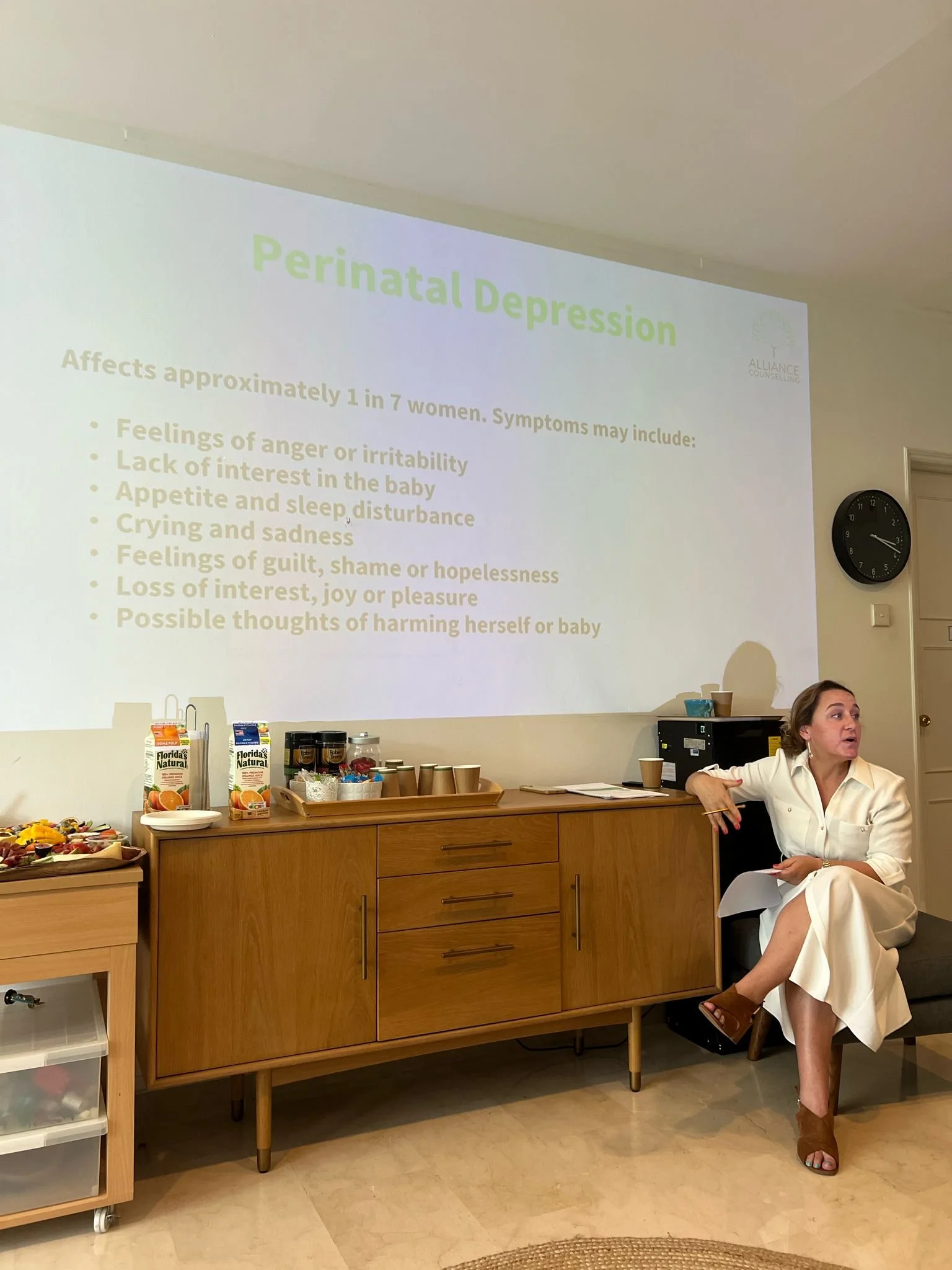
This one-day in-person training equips counsellors, psychologists and social workers who support pregnant and postpartum women and their partners. Across the day we will cover screening and differential diagnosis of perinatal mood, anxiety, trauma and bipolar disorders, using validated tools to guide triage and risk escalation. We will look at mental health needs linked to infertility, pregnancy loss and NICU experiences, and how to provide grief-informed, family-centred care.
Participants will learn how to assess trauma in the perinatal period, teach practical stabilisation skills and plan appropriate referrals for PTSD. We will apply brief, evidence-informed interventions adapted to the perinatal context, including ACT, CBT, IPT, EMDR, mindfulness, with considerations for sessions where baby or partner is present.
The training awards 6 CPD hours and is Postpartum Support International approved, counting toward the PMH-C 6-hour Advanced requirement.
For questions about PMH-C eligibility, contact me.
This focused, practice-led workshop is for counsellors, psychologists, social workers and allied perinatal professionals who support clients after difficult or traumatic births. We will clarify what constitutes traumatic childbirth versus typical postpartum distress and when to escalate care. You will see how to use brief screeners such as the City Birth Trauma Scale and PCL-5 to guide triage, then translate assessment into an EMDR case plan.
Across the session we will map a target sequence from pregnancy through birth to the postnatal period, teach stabilisation and grounding skills that work during pregnancy and breastfeeding, and cover practical adaptations when baby is in the room. We will walk through delivering EMDR phases 2 to 8 safely and effectively, including telehealth options, managing medical and sensory triggers, and planning measurement-based aftercare and relapse prevention.
Duration: 2.5 hours
Format: In person (Singapore)